

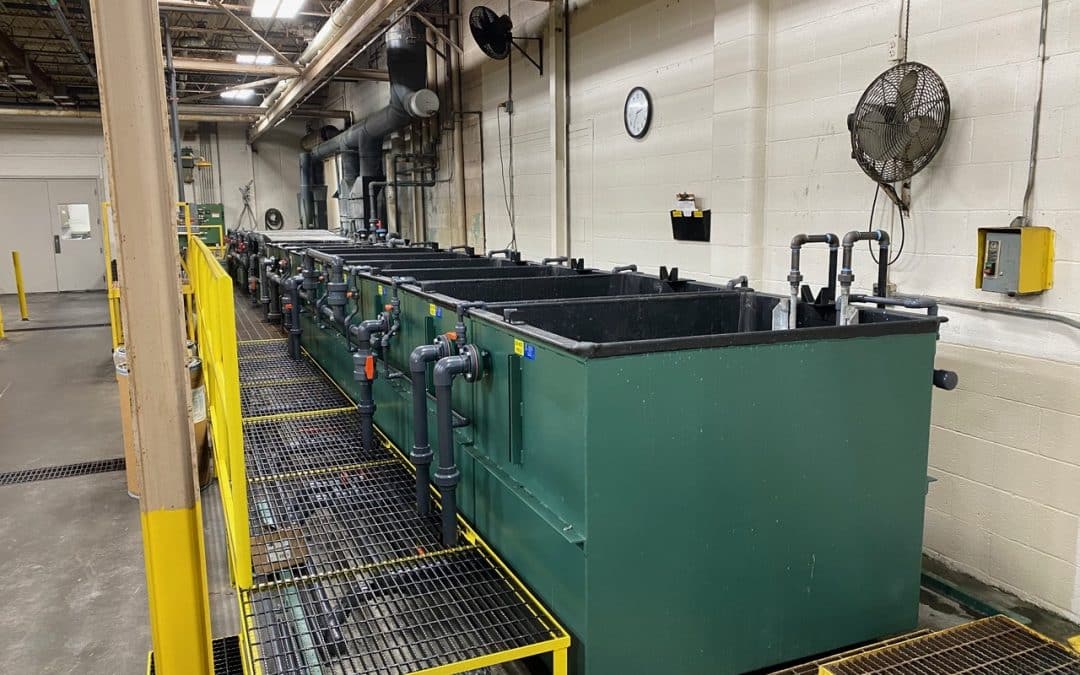
If you run a plating/coating shop, or if you manage equipment maintenance, you already know how chemical tanks take a beating. Acids, caustics, and heat work against bare steel every hour a bath is running. Using unlined tanks, or the wrong liner choice, is like letting chemical corrosion eat right into your bottom line.
Properly engineered plating tank liners quickly pay for themselves:
- Less risk of early failures while extending maximum service life of your high-cost equipment.
- Preventing contaminated batches of parts, which is just money down the drain.
- Minimizing unplanned downtime: on the shop floor, time is money.
Since 1958, Proco has been the leading provider of rubber tank liners for plating shops and manufacturers nationwide that utilize in-house plating/coating processes. Electroplating, electroless nickel, immersion coating, anodizing…we put together a guide that breaks down how to match a rubber liner to your specific process.
Choosing the Best Liner for Electroplating Tanks
Electroplating tanks deal with a mix of acidic and alkaline metal-salt baths (nickel, chromium, zinc, copper) along with constant physical wear from racks, anodes, and part handling. It’s a harsh environment, especially for bare metal.
Your electroplating tank liner needs to resist multiple types of chemical attack along with abrasion at the same time. If you don’t choose a tough enough rubber, PVC or polypro to stand up to abrasion, your liner is bound to wear out faster than expected no matter how careful you are with loading and unloading, and you’ll be back to square one.
Electroplating Tank Liner Selection Chart:
| Bath Chemistry | Typical Conditions |
|---|---|
| Nickel and copper sulfate baths | Mild acidic, ambient to moderate temp |
| Chromium plating baths | Elevated temperature, oxidizing |
| Acid zinc chloride baths | Ambient to moderate temp |
| High rack/anode contact areas | Continuous mechanical wear |
Electroplating Tank Liner Selection Chart:
| Bath Chemistry | Typical Conditions |
|---|---|
| Nickel and copper sulfate baths | Mild acidic, ambient to moderate temp |
| Chromium plating baths | Elevated temperature, oxidizing |
| Acid zinc chloride baths | Ambient to moderate temp |
| High rack/anode contact areas | Continuous mechanical wear |
Choosing the Best Liner for Electroless Nickel Plating Tanks
Electroless nickel is the toughest chemistry in this guide. These baths run acidic, typically pH 4.5 to 5.0, and they’re held at sustained high temperatures, often 185 to 195°F for the full plating cycle. The high heat and acidity combination ages standard rubber compounds faster than almost any other plating process, which narrows your options considerably.
Quick tip: if your shop runs electroless nickel and you’re seeing liner issues sooner than expected, bath temperature is usually the first thing worth checking against your liner’s rated service range.
Electroless Nickel Tank Liner Selection Chart:
| Bath Condition | Typical Range |
|---|---|
| Operating temperature | 185 to 195°F sustained |
| Bath pH | 4.5 to 5.0 (acidic) |
| Long-duration cycles | Continuous, multi-hour runs |
Choosing the Best Liner for Immersion Coating Tanks
Immersion plating keeps racks and parts fully submerged for extended periods, often longer than electroplating cycles. The chemistry itself may be similar to electroplating baths, but the liner needs to hold up under sustained, uninterrupted contact rather than shorter exposure windows.
So you likely don’t need to use an exotic compound, but it’s crucial that you confirm your liner is rated for continuous immersion duty, not just splash or intermittent contact.
Immersion Coating Tank Liner Selection Chart:
| Bath Chemistry | Typical Conditions |
|---|---|
| Acid chloride baths | Continuous full immersion |
| Alkaline zinc baths | Ambient to moderate temp, continuous |
| Pretreatment/pickling baths | Concentrated acid, ambient temp |
Choosing the Best Liner for Anodizing Tanks
Anodizing isn’t plating in the traditional sense, but it shares the same demands on tank linings. Proco has a lot of experience working with commercial anodizers and metal shops with in-house anodizing, which is why we’re including it here.
Sulfuric acid anodizing typically runs cool, often held tightly between 65 and 75°F, since even small temperature swings change coating quality. Chromic acid anodizing runs warmer, generally 90 to 105°F. The acid concentration and temperature together determine which rubber compound will actually hold up, so this is one area where guessing at a liner instead of matching it to your exact bath specs can cost you.
Anodizing Tank Liner Selection Chart:
| Bath Type | Typical Conditions |
|---|---|
| Sulfuric acid anodizing (below 50% concentration) | 65 to 75°F, tightly controlled |
| Sulfuric acid anodizing (50 to 70% concentration) | Elevated temperature tolerance needed |
| Chromic acid anodizing | 90 to 105°F |
Warning Signs of Tank Liner Failure: What to Look Out For
How do you know when it’s time to replace your coating tank liner? What can the failure mode tell you about your choice in liner material? We put together a list of the common ones:
- Blistering or bubbling on the liner surface – Raised bubbles, especially larger than 2 inches across, often mean chemical solution or moisture has gotten trapped between the rubber and the tank wall, a sign the lining has already been breached even if you don’t see a leak yet.
- Discoloration or staining, particularly yellow or greenish tones – These stains typically indicate acid seepage reaching the steel underneath and starting to corrode it, and the discoloration usually gets worse the longer it goes unaddressed.
- Cracking, brittleness, or a stiff, “aged” texture – A healthy liner should still feel flexible. If it’s gone hard, brittle, or cracked, sustained heat or chemical exposure has likely degraded the compound past its usable service life.
- Delamination or lifting at seams, welds, and edges – Rubber separating from the tank wall, especially near welds or corners, points to an adhesion failure and is one of the most common places liners begin to fail first.
- Unexplained bath chemistry changes or contamination – If your plating bath is drifting out of spec without an obvious process cause, a compromised liner allowing metallic contamination into the solution could be the culprit.
- Small holes, including pinholes – Even tiny defects can let bath chemistry reach bare steel, and what starts as a pinhole often grows into active corrosion and a larger leak if it isn’t caught early.
- Rust streaks or corrosion visible through or around the liner – Any sign of rust bleeding through the liner means the steel underneath is already being attacked and the liner is no longer doing its job in that spot.
- Unusual odors or fluid loss from the tank – A drop in bath level or a chemical smell where you don’t expect one can indicate a breach you can’t see directly, especially on tank floors or lower sidewalls.
Extended Tank Life Engineered from the Inside Out
A few patterns hold true across pretty much all industrial coating and plating processes:
- Sustained heat is the fastest way to age a rubber compound before its time, so if your bath runs hot for hours at a stretch, that alone should shape your liner choice.
- Acid concentration matters as much as acid type, since the same chemical at a higher concentration or temperature may call for a different compound entirely.
- Mechanical wear from racks, anodes, and parts handling adds a layer of stress that chemistry alone doesn’t account for, so abrasion resistance deserves its own line item in your liner spec, not an afterthought.
If you’re evaluating a liner replacement, a re-lining project, or a new tank build, matching the compound to your actual bath conditions up front is the single biggest factor in getting years of service life instead of a liner that fails unexpectedly in mere months.