

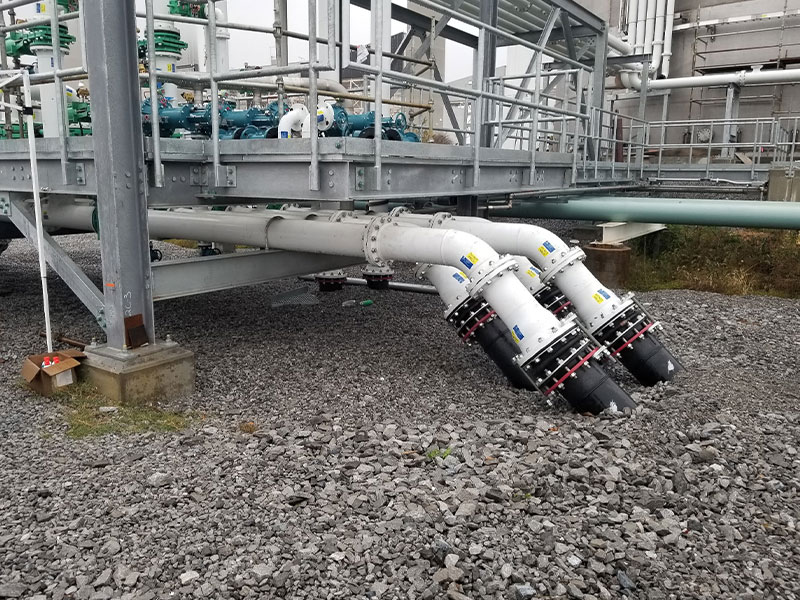
If you’re in the business of managing slurry lines, bulk material conveying systems, or high-wear process piping, you already know how bad the headaches can be with pipe failures. You spec out a standard steel pipe, it installs fine, and six months later you’re pulling it out and starting over. The wear never stops, which means neither do your maintenance costs.
At Protective Coatings Inc., we see this problem constantly across mining, aggregate, power generation, cement, and industrial processing operations. Our answer is a hybrid pipe solution that pairs steel pipe with interior rubber or ceramic linings, giving you the structural toughness of steel on the outside and a wear-absorbing layer on the inside.
We’ve carefully engineered our pipe lining and coating solutions, from material choice to application, in order to maximize equipment reliability and minimize your long-term maintenance requirements.
Why Steel Isn’t Tough Enough for Many High-Wear Environments
For many dry or low-velocity applications, steel performs well on its own. But in high-velocity slurry service, wet abrasive environments, or lines carrying sharp, angular particles, steel loses the battle against erosive wear over time.
The problem is that standard pipe wears from the inside out. Once the wall thins to a critical point, you’re looking at unplanned downtime, emergency repairs, and potential safety issues. For a plant manager trying to hit production targets, that scenario is unacceptable.
The Advantages of Hybrid Pipe Linings vs. Bare Steel
Adding a rubber or ceramic lining to the inside of steel pipe addresses the core wear mechanism directly. Here’s how each lining option contributes to the overall system performance:
- Rubber linings excel in slurry applications where particles are fine to medium in size and there’s a significant fluid component. Rubber absorbs impact energy and resists cutting wear. It also provides a secondary benefit in noise reduction and corrosion resistance, which matters in wet process environments.
- Ceramic linings, typically alumina-based tiles bonded to the pipe interior, are the preferred choice for highly abrasive, high-velocity applications with coarse or angular particles. Ceramic is extremely hard and holds up well against the kind of wear that would quickly erode steel.
- Combined rubber-backed ceramic systems offer the best of both worlds. The rubber backing absorbs impact and vibration, while the ceramic surface handles abrasion. This layered approach is particularly effective in elbows and other high-wear zones where turbulent flow concentrates abrasive contact.
When you combine any of these lining systems with a steel outer shell, the pipe becomes far more resilient than either material could achieve independently. The steel handles structural loads, external impacts, and installation stresses. The lining handles the wear.
For more information, with a specific focus on mining operations and aggregate plants, see our previous article: Rubber-Lined Pipe vs. Bare Steel
The Real Benefit: Longer Service Life and Lower Total Cost
From a process engineering standpoint, the value proposition is easy to calculate. Extending pipe replacement intervals from six months to three or four years translates directly into reduced labor, fewer planned and unplanned shutdowns, and lower material costs over the life of the system.
For purchasing and operations managers, the initial cost of hybrid pipe construction is higher than standard steel pipe, but the total cost of ownership is almost always lower. When you factor in the labor involved in pulling, replacing, and reinstalling pipe in a live production environment, a longer-lasting solution pays for itself quickly.
Plant managers also benefit from improved system predictability. Knowing that a critical slurry line has been engineered with a proven wear-resistant design reduces the number of variables that can disrupt production schedules.
Proco’s Approach to Abrasion-Resistant Pipe Linings
We fabricate hybrid pipe solutions to customer specifications, working from drawings, application data, and material requirements. Our team reviews the specific wear conditions your system faces, including particle size, velocity, concentration, and pipe orientation, before recommending a lining type. Elbows, straight sections, reducers, and custom fittings can all be built with hybrid construction.
We also work closely with engineers during the design phase to make sure flanging, connection details, and installation requirements are accounted for from the beginning. The goal is always to deliver a solution that fits into your existing system without complications.
If you’re dealing with chronic wear problems in your process piping, hybrid and lined steel pipe construction is worth a serious look. Contact the Proco team to discuss your application and get a quote.